Table of Contents
Shoulder press machine dimensions: Check the machine's operating height as well as its static height. Handles, loading arms and the user's reach may approach overhead obstructions differently across shoulder-press designs.
The practical output is a shoulder-press clearance drawing that distinguishes frame height, moving envelope and the required service access. This guide focuses on that decision for commercial facility teams, using documented product information and a repeatable review process.

What the equipment configuration changes
Shoulder-press selection requires a clear connection between the machine configuration and the facility’s intended users. Seat controls, grip arrangement and the documented starting position influence setup. Overhead movement also creates a layout question that may not be visible from the frame height. Review the complete operating envelope and avoid making universal exercise-position recommendations from a catalog image. Appropriate induction belongs with qualified staff using the selected model’s instructions.
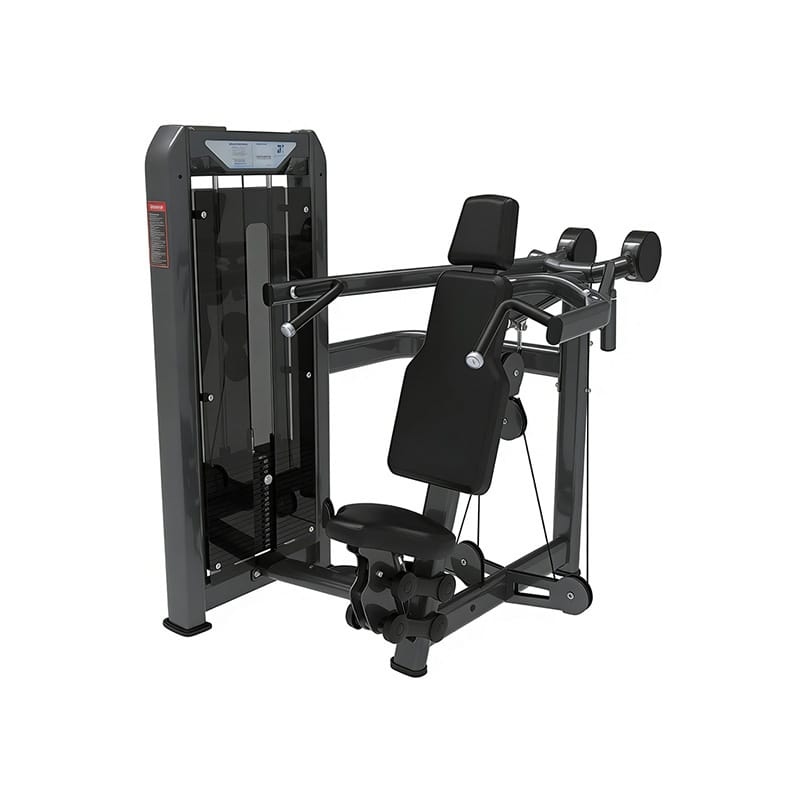
The Corexo U302 page lists dimensions of 1310 × 1370 × 1560 mm and an 80 kg stack. M303 is listed at 1670 × 1370 × 1590 mm with a 65 kg stack. The M303 page also displays an alternate factory model reference, which the supplier should reconcile with the commercial product name in the order documents. These numbers describe the listed equipment, not a universal measure of effective resistance or a judgment about which machine is better for every facility.
Include service access when arranging a shoulder-press station. The equipment may require inspection of parts above or behind the user position, and the prescribed work area should remain available after neighboring machines are installed. Give staff a practical defect-reporting process with an asset identifier and clear removal-from-use procedure. If an adjustment becomes loose, movement changes or a component is damaged, record the observation without asking a member to reproduce the problem. A competent service assessment should determine the next action.
Review the Strength Training Equipment range alongside Seated Shoulder Press Machine – U302 and Seated Shoulder Press Machine – M303. Keep the model-specific information with the project record so a later option change does not silently alter the assumptions.
The mistake to avoid
A low backrest does not establish a low operating envelope. Comparing only the frame height can miss the highest position of the moving components.
For shoulder press machines, the review should explicitly cover seat adjustment, grip arrangement, overhead movement, stack selection, operating envelope and model identification. Record the information for the actual quoted configuration. If a value or function is missing, ask a focused question and keep it open until the supplier provides the relevant evidence. An unanswered question is not proof that a feature exists or that a requirement has been met.
Shoulder Press Machine Dimensions: Practical Review
Prepare a vertical section as well as a floor plan. Mark the finished floor, ceiling, beams, lighting, ventilation outlets and other fixed objects. Add the selected machine and the full manufacturer-defined operating movement. The height printed in a catalog usually describes one aspect of the machine, while the usable space must also accommodate the relevant user position and the required clearance.
Ask for missing geometry explicitly. The highest position of a moving component, the user’s elevated foot position or the effect of an adjustable setting may not be included in a standard product table. Do not invent those measurements or borrow them from a similar model. Request the correct drawing and have the responsible project team review it against the intended use. Keep dimensions and units consistent so an apparent fit is not the result of a conversion mistake.
Carry the approved section into installation and acceptance. Equipment placed slightly differently can bring an overhead movement under a beam or light fitting. Confirm the installed orientation and location before opening the station. Future changes to flooring, ceiling fixtures or equipment settings may also affect the review. Preserve the original assumptions in the handover file and require an appropriate reassessment when a material part of the arrangement changes.
A practical scenario to work through
Two shoulder presses with similar static heights can have different moving-arm arrangements and access requirements. A ceiling fixture above one side of the bay may therefore matter more than the overall room height. Request the relevant movement drawing for the selected configuration and review the installed position. The U302 and M303 catalog dimensions help identify the models, but they do not supply a complete overhead clearance calculation. Preserve that distinction in the layout record.
Obtain the full movement drawing for the chosen configuration. Review ceiling fixtures, neighboring stations and the access needed to inspect the top of the machine.
Treat this as a planning example, not a report of a measured customer installation. Record the room conditions, model revision and people involved in your own review. A useful result explains why the arrangement works under those conditions and identifies what would trigger another review, such as a different configuration, location, attachment or operating program.
Record the decision and its evidence
| Review item | Evidence to keep | Decision it supports |
|---|---|---|
| Primary question | Check the machine's operating height as well as its static height. Handles, loading arms and the user's reach may approach overhead obstructions differently across shoulder-press designs. | The facility requirement being addressed |
| Configuration | seat adjustment, grip arrangement, overhead movement, stack selection, operating envelope and model identification | Whether the selected model matches the intended operation |
| Practical review | Obtain the full movement drawing for the chosen configuration. Review ceiling fixtures, neighboring stations and the access needed to inspect the top of the machine. | Whether the proposed arrangement works in the actual room |
| Open questions | Missing or inconsistent drawings, functions or model references | What must be clarified before acceptance |
| Final output | A shoulder-press clearance drawing that distinguishes frame height, moving envelope and the required service access. | A traceable handover to purchasing and operations |
Keep the final decision at the level of the installed asset. The handover should identify the selected configuration, accepted documents, outstanding non-critical actions and the people responsible for follow-up. For later replacements, retain references for seat controls, grips, pads, selector components and manufacturer-approved transmission parts. That makes it easier to distinguish a supported replacement from a visually similar substitute and gives the service team a useful starting point when a question arises.

References and scope of the review
The references below provide context for equipment, access, inspection and maintenance review. They do not certify a Corexo model or replace the selected machine’s instructions. U.S. and UK guidance must be interpreted for the relevant project location; the responsible local professionals should determine applicable requirements.
- ISO 20957-1:2024 scope — General stationary-equipment safety framework; obtain applicable model evidence.
- U.S. Access Board sports-facility guidance — U.S. accessibility context; apply the requirements relevant to the project location.
- HSE equipment inspection guidance — Inspection planning, competence and condition records in the UK work-equipment context.
- HSE equipment maintenance guidance — Planning competent maintenance and safe working arrangements in the UK context.
Prepare a focused equipment enquiry
Send Corexo the intended facility type, project location, quantity, selected model options and the decision record described above. Include a measured drawing or the relevant operating observations when they affect the enquiry. Ask for confirmation of the exact configuration, current manual, packing information, installation scope and support terms. Do not let an unresolved technical question disappear into a general request for a quotation.
The Corexo cooperation process and project enquiry team are starting points for discussing the requirement. For shoulder press machine dimensions, the requested outcome is specific: a shoulder-press clearance drawing that distinguishes frame height, moving envelope and the required service access. Agree on that deliverable before the order is finalized, then use it during acceptance and operational handover.
Frequently asked questions
What should the team decide first?
Check the machine's operating height as well as its static height. Handles, loading arms and the user's reach may approach overhead obstructions differently across shoulder-press designs. Start with the facility requirement and the exact configuration rather than a broad category label. Keep any unresolved information visible in the project brief.
What is the most common assumption to challenge?
A low backrest does not establish a low operating envelope. Comparing only the frame height can miss the highest position of the moving components. Request evidence for the selected model and do not transfer a capability from a similar-looking machine or another product in the series.
How can the proposed arrangement be checked?
Obtain the full movement drawing for the chosen configuration. Review ceiling fixtures, neighboring stations and the access needed to inspect the top of the machine. Use competent personnel for technical work and retain the conditions of the review so the result is meaningful to the operating team.
Which record should be kept after selection?
A shoulder-press clearance drawing that distinguishes frame height, moving envelope and the required service access. Link it to the equipment identity, quotation and applicable manual revision. Update the affected parts when the configuration or installation location changes.
What information should go with a Corexo enquiry?
Provide the facility type, location, intended use, quantity, model options and the specific questions still open. Include the relevant drawing or operating observations. Ask Corexo to confirm configuration, documentation, delivery scope and support terms in the quotation rather than assuming standard terms.